

The Future of Mokume-gane
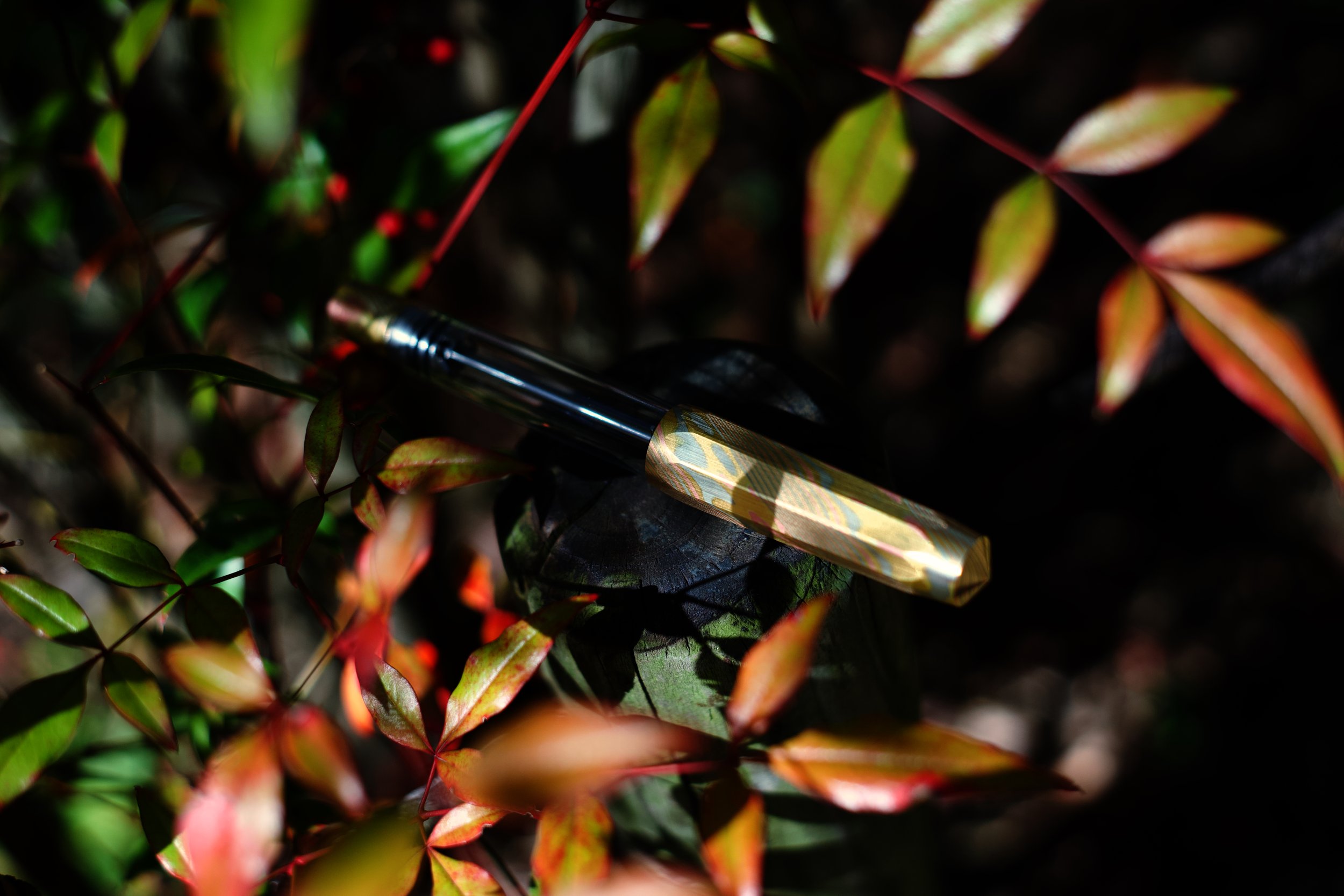
TABLE OF CONTENTS:
Advances In Technology Led to a More Widespread Use of Mokume-gane
Recognition of Mokume-gane as a Form of Traditional Craft in Japan
Revitalisation of Mokume-gane Through an International Community
The revival of Mokume-gane as an artform is an inspiring example of how the dedication and devotion to a craft through relentless experimentation and education can bring it back from obscurity. Mokume-gane is now extensively documented with readily available resources demonstrating the process, and is taught within and outside of Japan, enabling a new generation of artists to now inherit and innovate within the craft.
As such, although it was once a uniquely Japanese craft, the practice of Mokume-gane has now spread across the world with many metalsmiths and artists working with this technique to create their own visions of Mokume-gane works.
This article is the third in our series about Mokume-gane. To learn more about the origins and development of Mokume-gane over the last 400 years, please read our previous articles here:
Part 1: The Origins of Mokume-gane
Part 2: The Evolution of Mokume-gane: From Japan to the West and Back Again
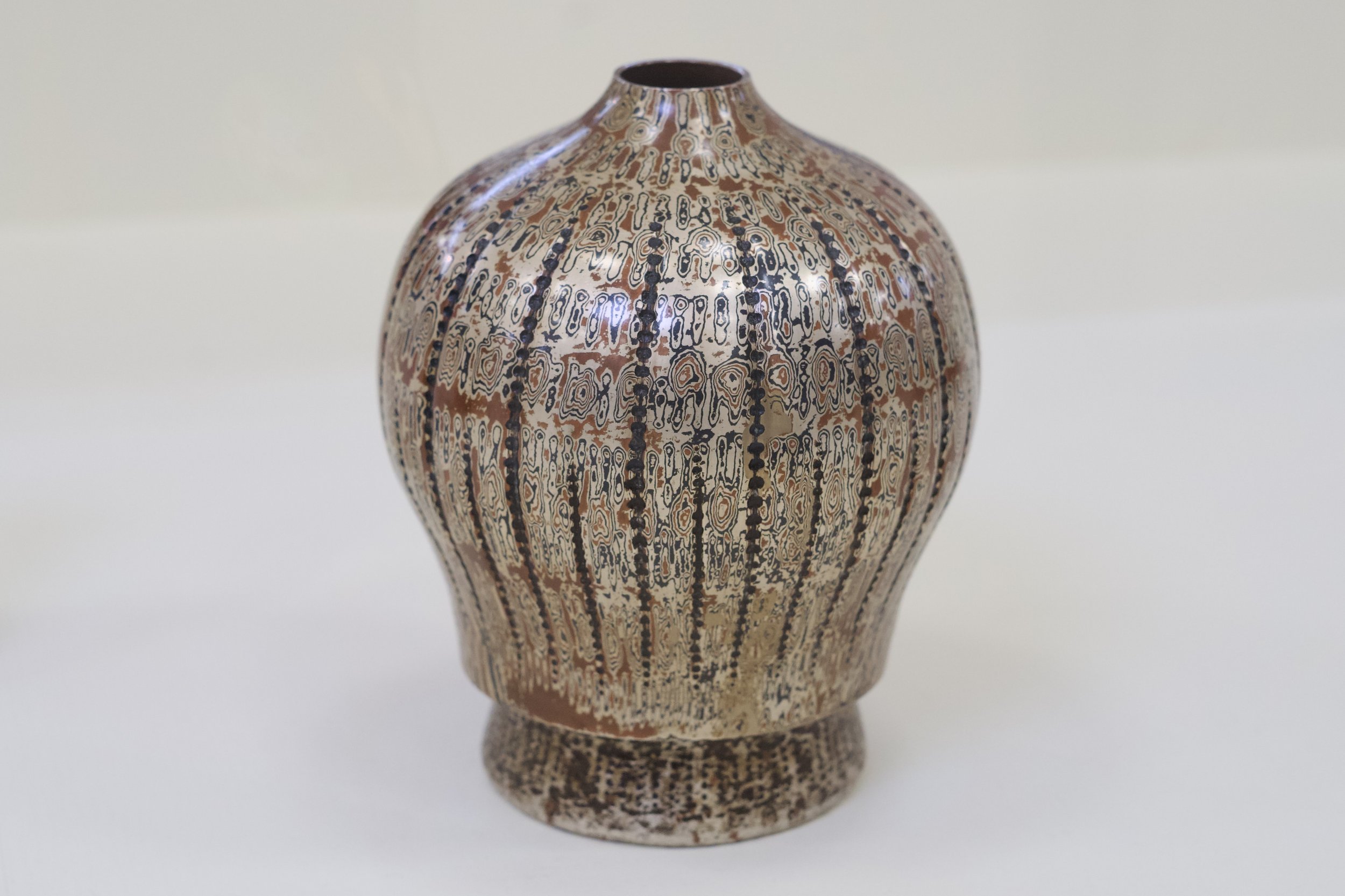
Mokume-gane Flower Vase by Tamagawa Norio, Living National Treasure, 72nd Japan Traditional Kogei Exhibition 2025, Tokyo. Image © Kyuseido.
Advances in Technology Led to a More Widespread Use of Mokume-gane
As covered in our previous article “The Evolution of Mokume-gane: From Japan to the West and Back Again”, advancements to the Mokume-gane technique using an electric kiln made headway in the USA in the 1980s, enabling a more widespread adoption of this technique in workshops that did not have the capacity to operate a gas kiln or charcoal forge.
This meant that more metalsmiths could now work with this technique with a higher chance of success, as well as being able to expand the use of the different types of metals that could be fused together.
Traditionally, a Mokume-gane billet was formed using copper, silver, gold, and copper-based alloys such as shibuichi and shakudo. This remained unchanged since its creation by Shoami Denbei as it was passed down through the different swordsmithing schools during the Edo period. However, after the revival of Mokume-gane in the 1970s, a newer generation of artists were interested in experimenting with the fusion of different metals to achieve a new means of expression.
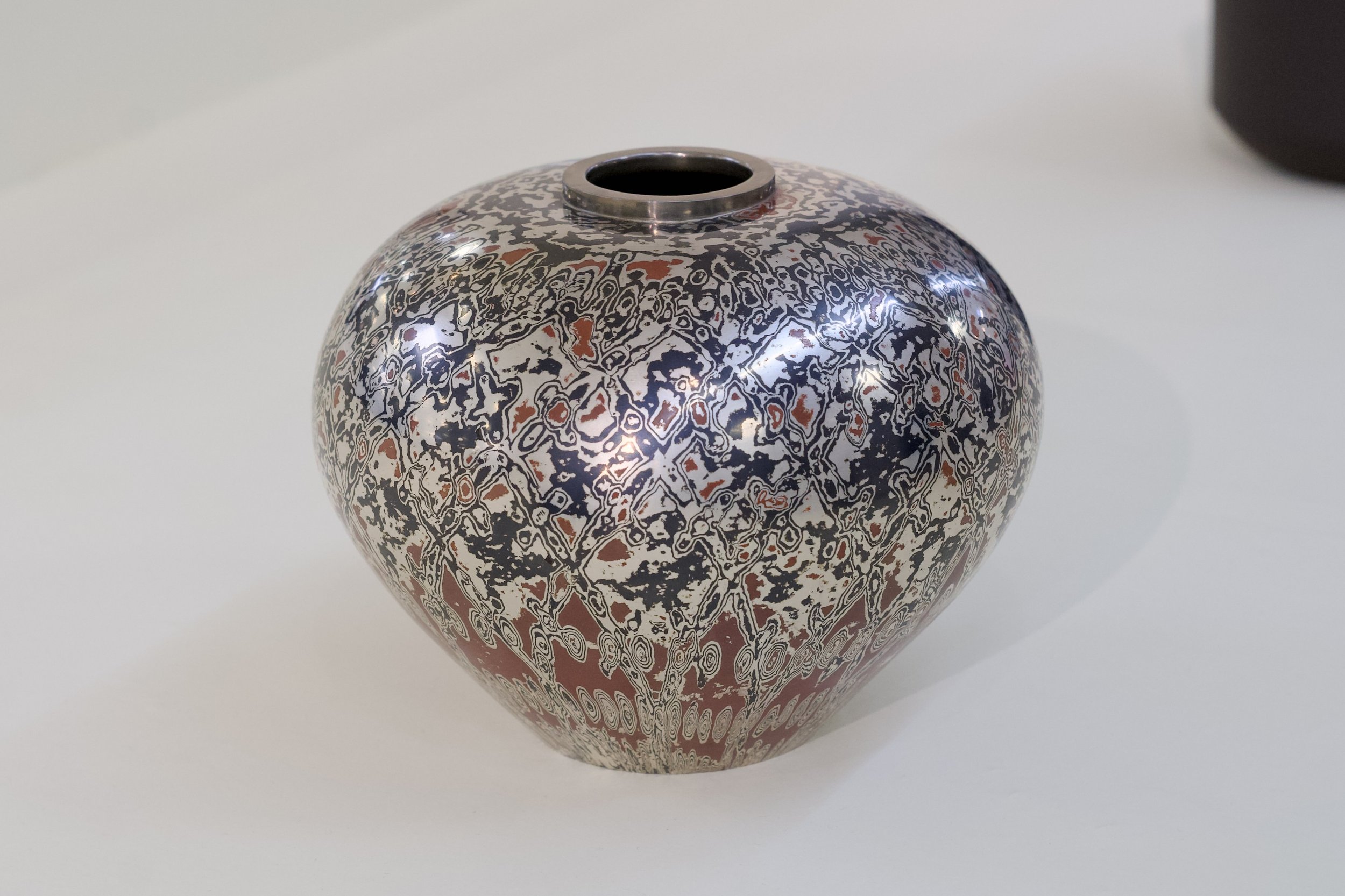
Mokume-gane Flower Vase by Nomura Satoshi, 72nd Japan Traditional Kogei Exhibition 2025, Tokyo. Image © Kyuseido.
Current Expressions of Art Using Mokume-gane
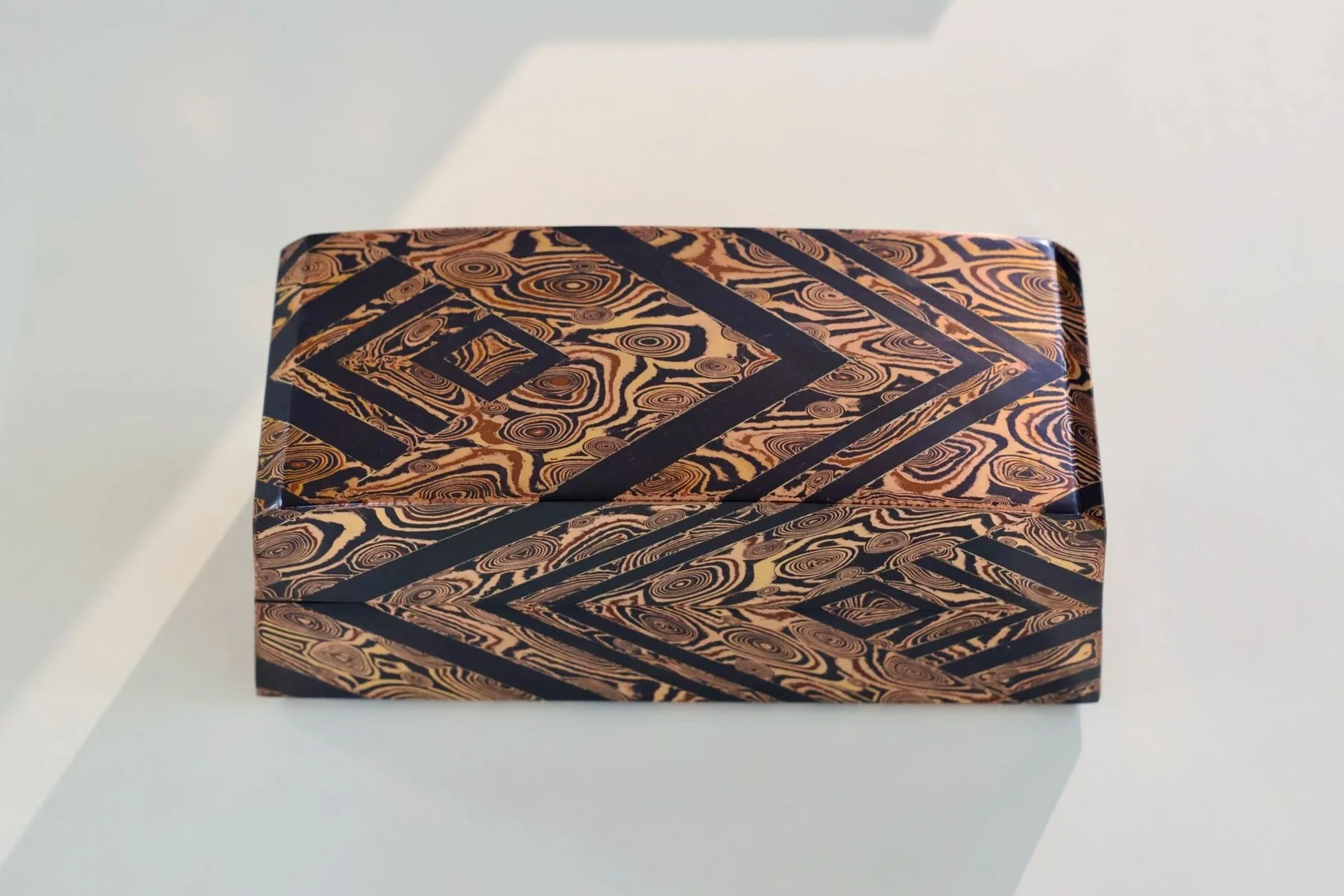
Mokume-gane Coffer by Hayashi Biko, 72nd Japan Traditional Kogei Exhibition 2025, Tokyo. Image © Kyuseido.
As this technique was incorporated into wearable items like jewelry and rings, metals such as gold, platinum, and palladium started to be incorporated into the design to create new expressions of tones and colours, while being able to resist oxidation and maintain their original coloration. The use of metals like titanium allowed for new colours such as blue to be incorporated into the design.
Currently, Mokume-gane is most commonly incorporated into small jewelry items such as rings, however there are artists that are interested in pushing the boundaries of what can be achieved with Mokume-gane and find their own means of expression with this art form. The recent shift towards contemporary art and fine art as a way to express Mokume-gane techniques also enabled new ways of working with this craft, using it as a form of expression outside of purely functional or practical uses.
Recognition of Mokume-gane as a Form of Traditional Craft in Japan
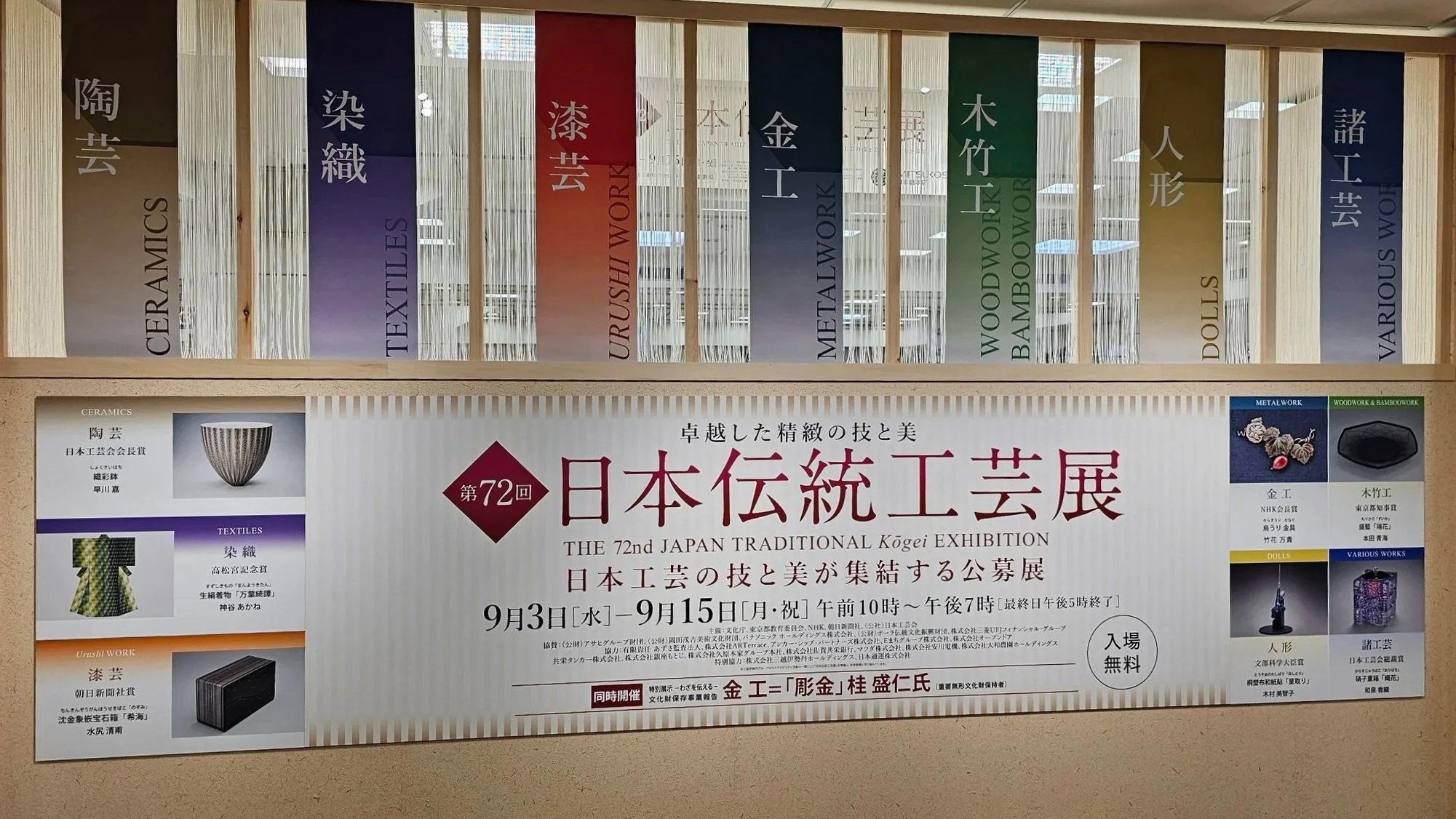
72nd Japan Traditional Kogei Exhibition, Nihombashi Mitsukoshi Department Store, Tokyo. Image © Kyuseido.
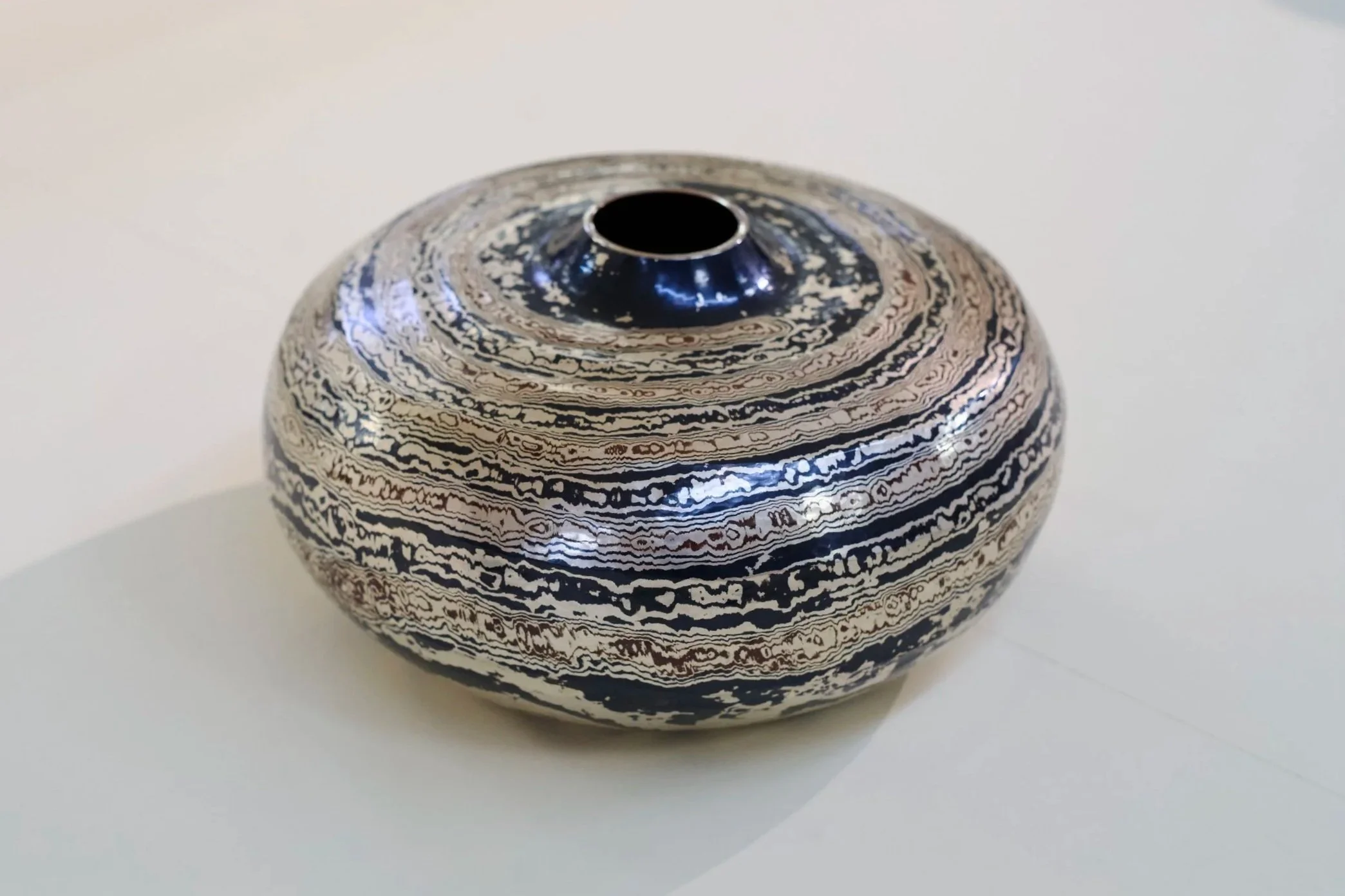
Mokume-gane Flower Vase by Tamagawa Tatsushi, 72nd Japan Traditional Kogei Exhibition 2025, Tokyo. Image © Kyuseido.
In September 2025, the 72nd Japan Traditional Kogei Exhibition (日本伝統工芸展) was held in the Nihombashi Mitsukoshi Department Store in Tokyo. This is an annual event that showcases some of the best representative traditional crafts recognised by the Japan Kōgei Association (日本工芸会), and often showcases works by Living National Treasures.
Several Mokume-gane works were shown at this exhibition, showcasing the renewed interest within Japan to continue exploring this technique and how different forms of expression can be achieved. The works on display highlight that Mokume-gane as a technique still has a lot of room for innovation and exploration, as there are countless forms of how this technique can be executed.

Mokume-gane Vase by Sako Ryuhei, 72nd Japan Traditional Kogei Exhibition 2025, Tokyo. Image © Kyuseido.
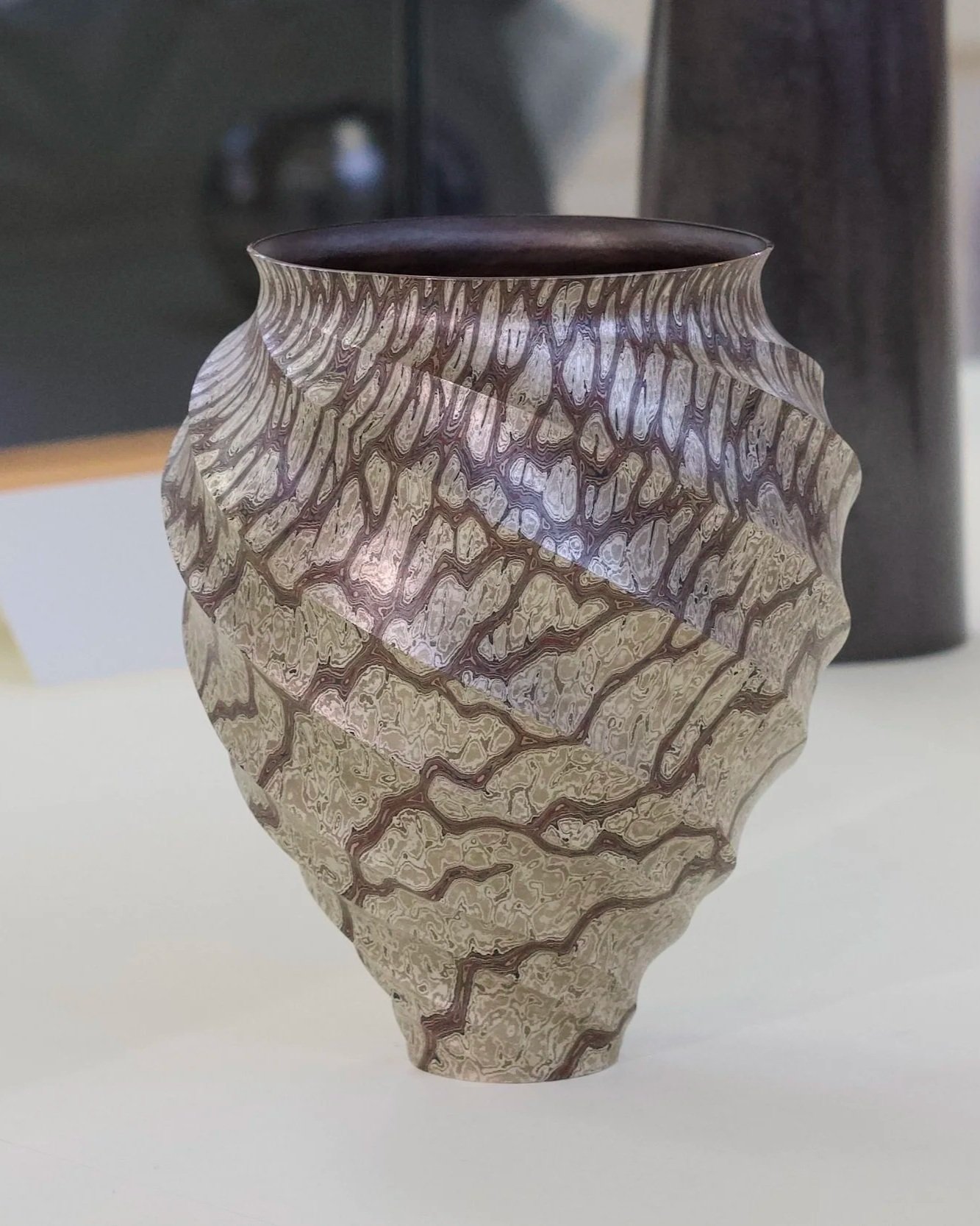
Mokume-gane Vase by Sako Ryuhei. Image © Kyuseido.
Although Japanese sword production is now mainly for ornamental purposes, Mokume-gane is still being used to create new works as demonstrated in the Contemporary Swords and Artworks Exhibition held at The Japanese Sword Museum from August to October 2025, continuing that legacy of its use in sword making in current times.
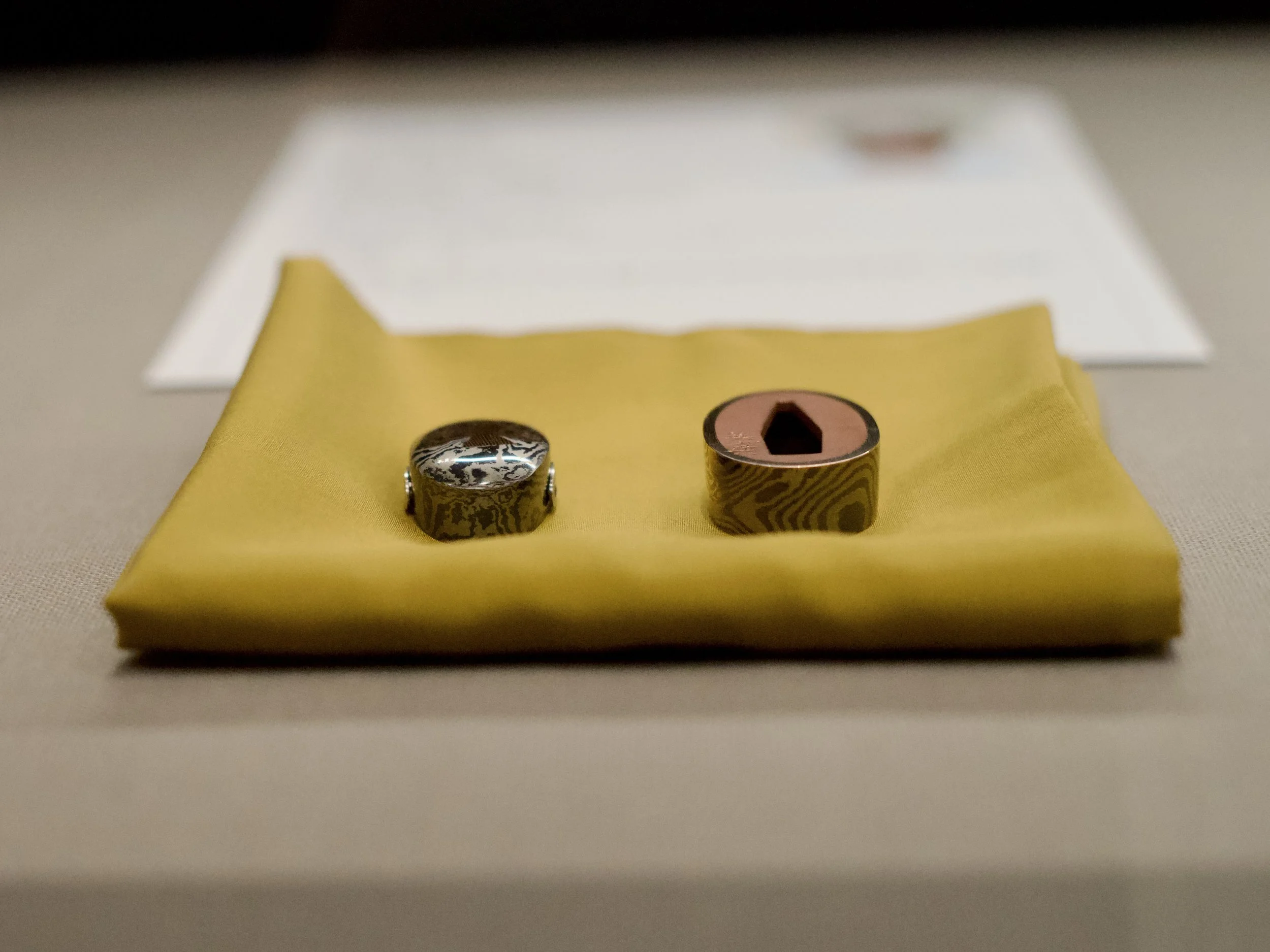
Mokume-gane Fuchigashira Sword Fitting by Misumi Kyohei, The Japanese Sword Museum, Tokyo. Image © Kyuseido.
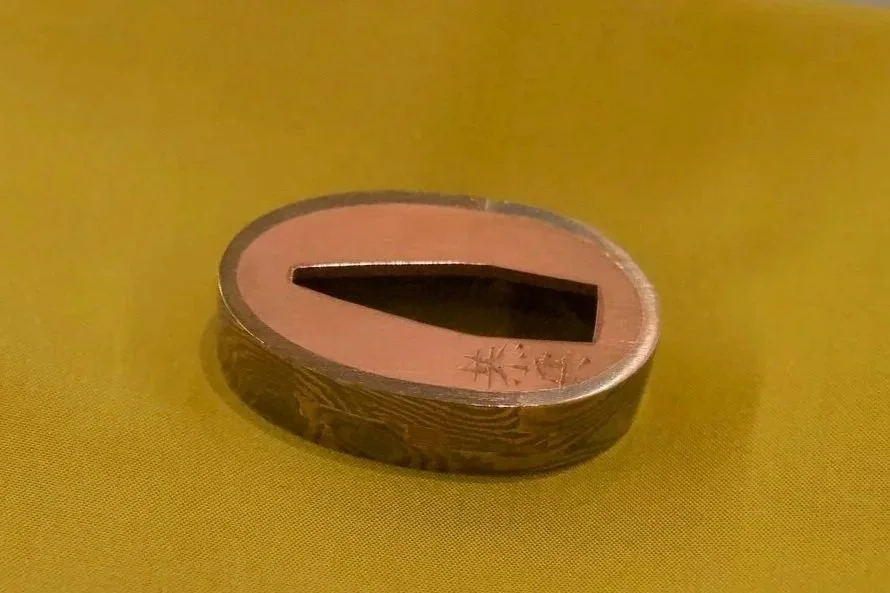
Mokume-gane Fuchigashira Sword Fitting by Misumi Kyohei, The Japanese Sword Museum, Tokyo. Image © Kyuseido.
In this piece of work, Misumi Kyohei has taken inspiration from the traditional methods of woodwork joinery without nails known as Sashimono (指物), to create this Fuchigashira (縁頭) set (Sword-hilt and Pommel) using three different patterns of Mokume-gane.
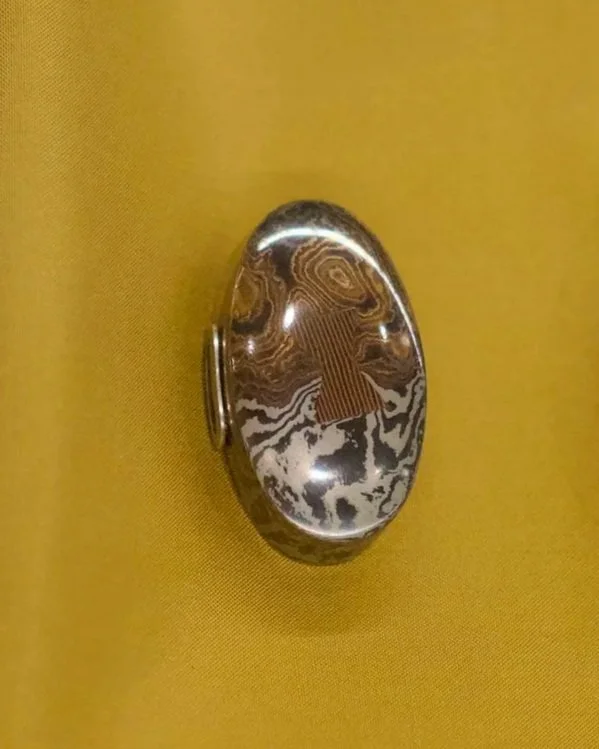
Mokume-gane Fuchigashira Sword Fitting by Misumi Kyohei, The Japanese Sword Museum, Tokyo. Image © Kyuseido.
What Does the Future Hold for Mokume-gane?
We can observe in recent years that Mokume-gane is increasingly appreciated and sought after in contemporary works and art pieces, which is a positive direction for ensuring this craft can continue to flourish in the future.
In contrast, many traditional crafts in Japan have faced a slow decline ever since the modernisation and industrialisation from the Meiji period, as they struggle to keep up with the changing social and economic landscape that has swept across not only Japan but the entire world over the last 150 years. This decrease in demand is in part due to a shift in perception of many traditional crafts in most of society today, and also the difficulty for crafts to match the economies of scale to compete with mass produced products.
This was what Mokume-gane was facing up until the 1970s, as only less than a handful of craftspeople were still working with Mokume-gane in Japan at that period of time. The apprenticeship system that enabled this transfer of knowledge from one generation to the next was no longer effective in keeping the tradition alive, due to the uncertain future and questionable stability of continuing this line of work for the younger generation.
Coupled with the fact that Mokume-gane is a highly labour intensive and technically complicated form of metalwork with a high risk of failure, meant that it was extremely challenging to pass this information effectively to the next generation and therefore it would have likely faded out within Japan in the successive generations if it was not for the interested from the international community to learn more about this craft.
Mokume-gane as a Craft and Artform
Many of what we now consider traditional crafts in Japan were created from a necessity for functional use. Since Mokume-gane was created from existing metalworking techniques used to create sword furnishings and blades, it’s primary function was more akin to a form of decorative art than purely craft. As we look at the different examples of Mokume-gane sword guards, it is clear that the expression and ideas of the artisans comes through, and it was very much a medium for the expression of artistic designs.

Mokume-gane tsuba with Sparrow and Hawk by Hamano Masanobu, The Walters Art Museum, Baltimore.
The adoption of electric kiln fusing and the development of commercially produced Mokume-gane blanks and rods, further expanded the ability for others outside of metalworking to work with this material and continue to innovate on the range of products that could be created with this technique.
In the past, Mokume-gane has been used to decorate the Japanese Yatate, which is a portable brush writing set. Now with the modern fountain pen, we have also adapted this material to add an artistic flair to our Kakari and Kosumi FS model.
Revitalisation of Mokume-gane Through an International Community
While continued efforts are being made within Japan to protect various traditional crafts, it is undeniable that the craft industry as a whole still struggles to keep up with the changes in modern society.
Arguably it was the effort to spread the information and knowledge of Mokume-gane outside of Japan, exposing it to a more international audience, which was what has enabled this craft to have a much better chance of enduring the decades ahead. Many of the artists working with Mokume-gane are now found outside of Japan, which fosters a greater appreciation of this craft, leading to a second wave of artists pursuing Mokume-gane back home in Japan.
Can we therefore learn something from this approach to apply to other forms of craft, to keep these traditions alive while also supporting new innovations that might arise?
Like all crafts, the continuation of Mokume-gane depends on how it can still be used to create meaningful and useful items for people in today’s society to appreciate and use. The efforts from contemporary Mokume-gane artists to develop new techniques and educate the community on the technical knowledge has enabled this field to come a long way, and will continue to serve as an inspiration for many more who come after.
View Our Related Products:
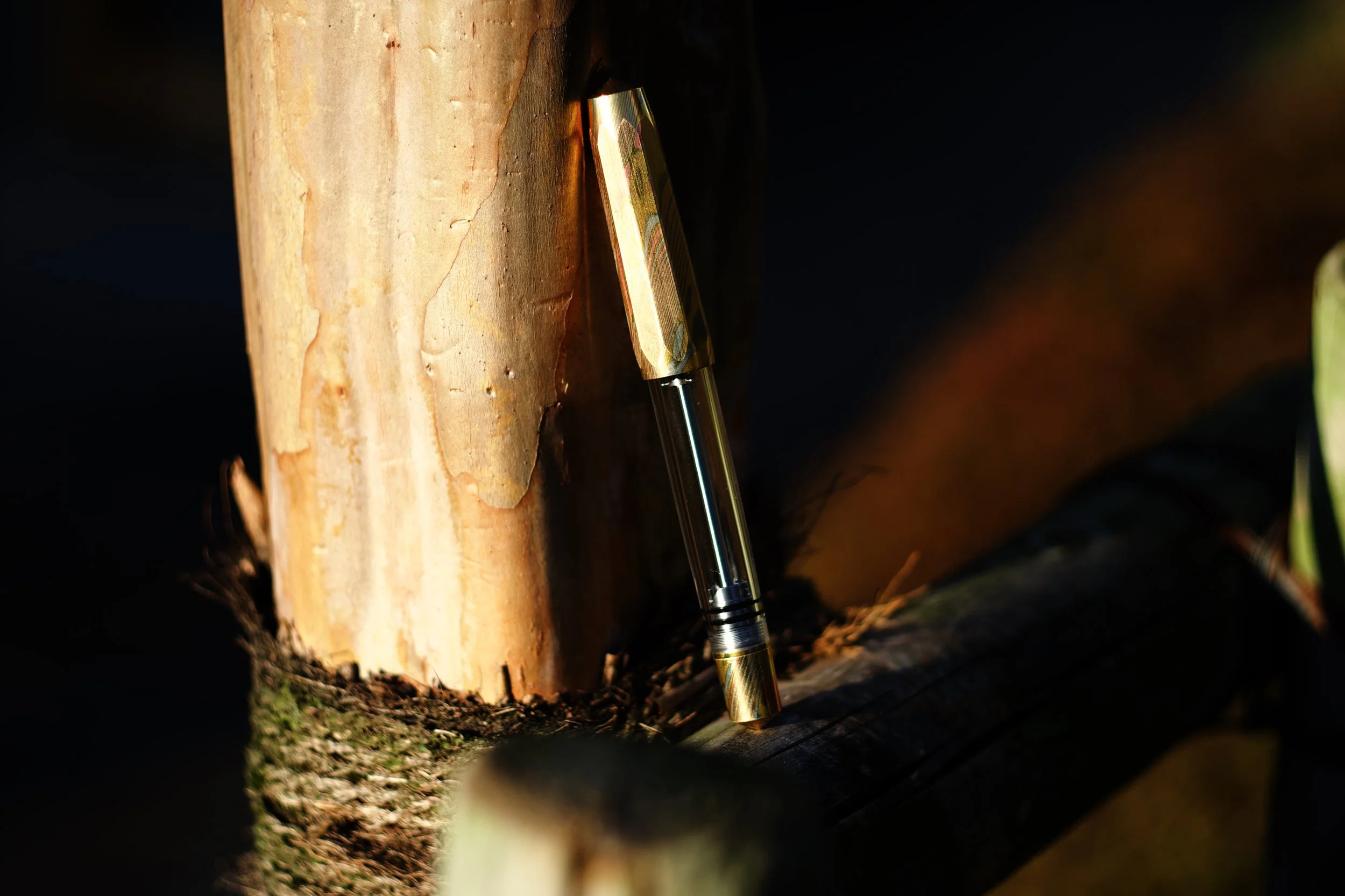
Mokume-gane is an artisanal Japanese metalworking technique taking several different metals and forging them into a single piece of material. The word Mokume-gane (木目金) translates to “Woodgrain/Woodeye” (Mokume - 木目) “Metal” (Gane - 金) and is characterized by its distinct woodgrain pattern formed by the layering of different metals.
As this is an artisan material, no two pens are identical and will have their own unique expressions and imperfections but all of these pens will evolve with the user to become pieces of art in their own right.
The Mokume-gane is also available in the Kyuseido Kakari FS model.


Mokume-gane is an artisanal Japanese metalworking technique taking several different metals and forging them into a single piece of material. The word Mokume-gane (木目金) translates to “Woodgrain/Woodeye” (Mokume - 木目) “Metal” (Gane - 金) and is characterized by its distinct woodgrain pattern formed by the layering of different metals.
As this is an artisan material, no two pens are identical and will have their own unique expressions and imperfections but all of these pens will evolve with the user to become pieces of art in their own right.
The Mokume-gane is also available in the Kyuseido Kosumi FS model.
Additional Resources:
NPO Japan Mokumegane Research Institute:
https://www.mokumegane.org/e/
The Japanese Sword Museum:
https://www.touken.or.jp/english/
Textbook of Mokume-gane:
https://www.amazon.com/Textbook-Mokume-gane-Masaki-Takahashi/dp/4990498216/
Websites About Mokume-gane:
https://www.mokume.com/
https://www.metmuseum.org/perspectives/metalworking-mokume-gane
https://mokume-gane.com/
Other Mokume-gane Resources:
https://www.mokume.com/mokume-gane-a-comprehensive-study/table-of-contents

